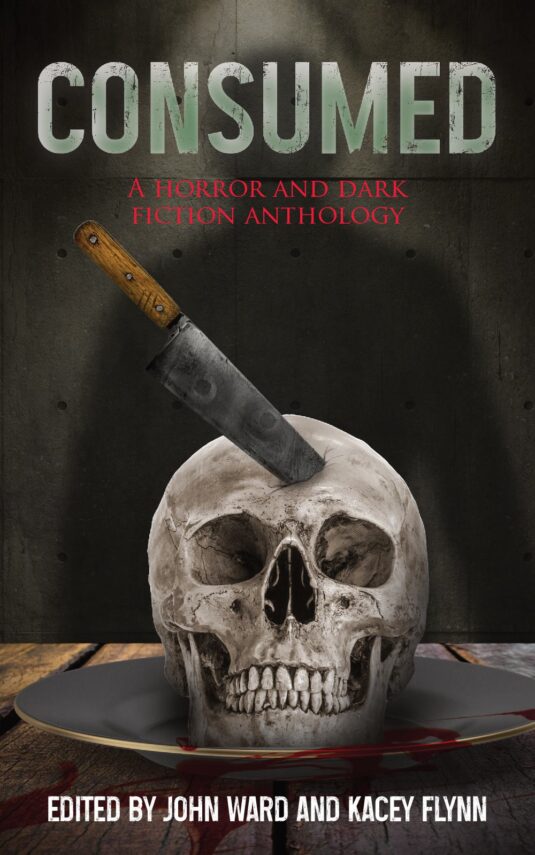
Consumed: a horror anthology
28 stories. One terrifying feast.
"Full disclosure: My story "Lunch at the Mahantongo" is featured here, among several other worthy works. I probably took the most obvious route for a collection called "Consumed," but thankfully, a lot of other writers here did not. Thus, we have Cedric Bell's unique take on werewolves (werewulves?) in "Junkyard Dogs" and Stacy Schonhardt's dark fairy tale "A Case of Necessity." Gordon Sun does some impressive world-building in "Vampin' It Up," while Evan Baughfman provides us with perhaps the book's bleakest tale with the holiday-themed "Wrong Month." But it is Rae Patterson's "The Night Menu" that will likely stay with me the most, a beguiling story about the love of food, and food cooked with love. "
Tom Coombe
Goodreads
A haunting read that will linger in your mind!
Consumed is delicious horror & dark fiction anthology, featuring 28 macabre tales on the theme of food and drink.
Featuring stories from:
U.M. Agoawike • Ed Ahern • K.G. Anderson • Evan Baughfman • Hannah Baxter • Cedric Bell • Jackson Bell • Tim Brown • Theo Carr • Tom Coombe • Marcus Field • Warren Frey • Gene Gallistel • Zach Gearey • E. Florian Gludovacz • Emma Hampp • Sarojshree Janaki • Hope Madden • Colin Matthews • Rick McQuiston • Rae Patterson • Stacy Schonhardt • Johanna Stumpf • Gordon Sun • Alex C. Telander • Mark Towse • Fendy S. Tulodo • John Ward
One deliciously deadly desert. A family Christmas interrupted by a game of trick-or-treat. A sentient barrel that knows the taste of human flesh. These are just a few of the macabre tales in Consumed, a food-themed horror anthology.
The stories in Consumed explore themes of consumption, bodily autonomy, and the monstrous by putting a unique spin on the familiar and essential act of eating. These spine-tingling tales introduce you to werewolves, mystery meat, murderers, cannibals, monstrous entities, and even lawyers! Consumed is an imaginative anthology of gruesome stories that celebrate food, drink, life, and death.
Bonus Q&A with the authors
Tim Brown
What inspired the darkest or most unsettling moment in your story? How did you ensure it resonated on an emotional level?
The moments towards the end are quite dark, but what I find most unsettling is the imagery of the dancers’ shoes against the glass floor. I remember seeing a GIF online of this and the sight of something so fanciful from a wrong angle really stuck with me. I hope it’s something that sticks with the reader as well.
Briefly walk us through your writing process. Do you start with a setting? A character? Or do you start with plot? How do you build tension throughout your stories?
With short stories, I usually start with a particular scene or image in mind. From there I build things out with characters, plot, and settings. I subscribe to the theory of tightening the screws on the character, until either the screws—or the character—finally shatter.
How do you think your story contributes to the broader horror genre? What themes or tropes are you subverting or exploring?
I think it’s a story that looks both at consumption and class divides. Hopefully I tilted the kaleidoscope just enough to give the reader something interesting to look at.
What authors or works have influenced your writing style and the tone of your story? Are there any particular horror stories that inspired you?
The main trick I used in this story should be familiar to anyone who read IT in the past. I tried to do a little bit of a mashup of Bret Easton Ellis and Stephen King between the two main characters, and I hope it works!
What’s the most unsettling thing you’ve ever experienced or seen that stayed with you? How has that influenced your writing?
Between where I live and what I do for a living, I’ve got no shortage of unsettling things I’ve witnessed. I think it’s a good thing, though. It makes me appreciate kindness and want to contribute more to my community to make it a better place. I tie that in to my writing by trying to give my characters moments of warmth by the fireplace before the flames spread and cremate a few of the slower ones.
What’s next for you after this anthology? Are you working on new projects? What can you share?
Tons, hopefully! I’ll be attending StokerCon this year for the first time, and I have a few short stories cooking. I also am working on editing and (hopefully) publishing a novel. I’ve got a website (timbrownwrites.com), X/Twitter (@timbrownwrites), and a BlueSky account (@timbrownwrites.bsky.social). I haven’t posted on there in a minute but I’ll be adding more stuff soon!
Joe Mitchell
Briefly walk us through your writing process. Do you start with a setting? A character? Or do you start with plot? How do you build tension throughout your stories?
My process varies from project to project, but most of the time I like to start with a small seed and then freewrite to see how the story grows and what ideas come to mind along the way. The seed could be a character, a snippet of dialogue, or an inciting incident, whatever gets words down on the page. This is my favorite method, and I think it’s how my best work is accomplished. I find it harder to complete a project if I plan too much ahead of the actual writing.
How do you think your story contributes to the broader horror genre? What themes or tropes are you subverting or exploring?
I’m not sure of how successful I was but my goal was to create something more subtle and psychological for the zombie/contagion genre. The idea of recovery has been something that interested me for a while too, and in particular how that might affect society. I think it’s probably something that could be explored beyond what I’ve written here.
What authors or works have influenced your writing style and the tone of your story? Are there any particular horror stories that inspired you?
I’ve been inspired by too many authors to list, although many of the big names will be familiar (Stephen King, Richard Matheson, Clive Barker, Poe, and so on). However, for the story in this anthology, the initial inspiration actually came from “What We Talk About When We Talk About Love” by Raymond Carver. I had the idea of writing something with the same basic premise but with a darker, more disturbing topic of discussion, and that’s what led to the story here.
What’s the most unsettling thing you’ve ever experienced or seen that stayed with you? How has that influenced your writing?
Oh, that’s between me and the shadow down the hall.
What’s next for you after this anthology? Are you working on new projects? What can you share?
I’m working on several short stories as well as a few longer works in the novel/novella range. Most of what I’m working on falls under horror and dark fantasy. Between my day job and childcare progress is rather slow, but at a minimum I hope to have a few shorter pieces out later this year or early next year.
Hannah Baxter
What authors or works have influenced your writing style and the tone of your story? Are there any particular horror stories that inspired you?
One author that has majorly influenced both my writing style and the tone of my story is H.P. Lovecraft. The breathtaking cosmic scope of his horror stories has been a lifelong fascination for me. Another is Carmen Maria Machado. Her writing demonstrates a seamless blending of the domestic and grotesque. A notable example of this would be her 2017 short story collection ‘Her Body and Other Parties’. One of her works, ‘Eight Bites’, where a woman’s extreme diet manifests a lifelong doppelgänger, was a significant source of inspiration for my own ‘Prime Cut’
What’s the most unsettling thing you’ve ever experienced or seen that stayed with you? How has that influenced your writing?
The most unsettling thing I’ve ever experienced was as a child, when I stumbled on what I thought was a sleeping fox basking on a sunlit rock while exploring the woods. Dazzled, I knelt down to stroke its belly, only for my fingers to slide right inside. When I withdrew, they were gloved with wet blood. The snoozing forest denizen was really a gory lifeless pelt carelessly discarded by a sadistic and wasteful hunter. It was a life-changing encounter, serving as both the end of my innocence and an endless well of inspiration. My inexperienced eyes to a darkness that thrived even in daylight, one that I still try to capture today in my writing.
What’s next for you after this anthology? Are you working on new projects? What can you share?
As the old saying goes, there’s no rest for the wicked. I’ve been working hard on several short stories and a novel. I’m hoping to get them all published at some point.
Alex C. Telander
What inspired the darkest or most unsettling moment in your story? How did you ensure it resonated on an emotional level?
The story began with me wondering what might happen if someone started feasting on cobwebs. My protagonist is a young girl, and as a parent of two, imagining her being badly treated by her father was something I was able to pull from my darkest nightmares.
Briefly walk us through your writing process. Do you start with a setting? A character? Or do you start with plot? How do you build tension throughout your stories?
I’m what they call a “pantser.” The beginning of a story idea comes to me and once I have a character I just sit down and start writing and let the character start telling me the story. Tension develops as conflict befalls the character, and I’m just as hooked as the eventual reader to find out what happens to them as the story progresses.
How do you think your story contributes to the broader horror genre? What themes or tropes are you subverting or exploring?
In Arenae, I’m playing around with child endangerment and how when you have no one else, it’s up to you to get yourself out of the situation. I’m also playing with body horror and even did research on spiders and arachnids for the story.
What authors or works have influenced your writing style and the tone of your story? Are there any particular horror stories that inspired you?
Stephen King is the author who made me want to be a writer and every time I read I read him I feel more inspired. For this story, I think I was also channeling some Clive Barker, as I went extra dark with the description and visceral feel. Eric LaRocca is another author I’ve been reading and I see some of his darkness in this story and the way the character is pushed to the limits.
What’s the most unsettling thing you’ve ever experienced or seen that stayed with you? How has that influenced your writing?
There are two events in my life that are burned on the inside of my brain. The first is when I was about 12 out on the water in a dinghy with my brother going too fast, and we hit a wave and the engine popped into neutral while the boat swung around. I was hanging onto the outboard motor handle, safe and sound, while my brother spun over the side into the water as the dinghy was turning around. He was under for only a few seconds, but it felt like years to me, and then popped up safe and sound on the other side. He got back in the boat, a little shaken up, and an hour later everything was fine. But I’ve never forgotten that consuming, enveloping terror as he went over the side.
The other moment is when my father and I heard this dog howling in pain and we went to investigate and a few houses down the neighbor’s dog had tried to jump of over the iron fence and had gotten the inside of his hind leg impaled on an iron spike and was just hanging there. My father and I, along with some other neighbors, went to help. I can remember helping to hold the dog up to relieve his pain; his hot blood fresh on my hands. Eventually a vet arrived and we were able to lift the dog off the spike and he was stitched up. But this was such a visceral experience I’ve never forgotten it.
What’s next for you after this anthology? Are you working on new projects? What can you share?
I’m always submitting stories to anthologies. I recently finished a first draft of a slasher novella called “Happy Carving Day” that plays around the Final Girl trope, as well as working on a novel version of my podcast, “Ostium,” which will cover the first three seasons about a guy who discovers a hidden town where there are no people but many doors that lead to different places in space and time.
Colin Matthews
What inspired the darkest or most unsettling moment in your story? How did you ensure it resonated on an emotional level?
I think it was actually the opening moment of the story that first captivated me. The image of a tree standing for decades, perhaps even hundreds of years, enduring every storm, only to suddenly face an axe striking its trunk, and then being sawn in two and pulled to the ground with no way to defend itself, is powerful. By presenting the story from the tree’s perspective, I aimed to create an instant sense of empathy in the reader and convey the idea that all living creatures are connected in some way.
Briefly walk us through your writing process. Do you start with a setting? A character? Or do you start with plot? How do you build tension throughout your stories?
Every time is unique. Typically, I begin with a character, but there are times when I create a setting or a situation first and then think about what kind of person would live in that world. I then try to imagine what type of person would experience the most struggle and suffering in that situation. Muahahaha…
How do you think your story contributes to the broader horror genre? What themes or tropes are you subverting or exploring?
I have always been fascinated by xenofiction and how non-human protagonists can provide unique and often unsettling perspectives on the human world. By telling the story from the tree’s point of view, I was able to explore themes of survival, adaptation, isolation, and the dangers posed by humanity. This approach also allowed me to delve into the nature of sentience and consciousness, all while hopefully creating a distinctive horror experience.
The story examines how we absorb emotions and feelings from those around us, often allowing their emotions to consume us. It highlights that every time we eat or drink, we also assimilate the essence of everything that food has been exposed to. Additionally, it reflects on how we all impact one another, ultimately sharing a collective experience.
What authors or works have influenced your writing style and the tone of your story? Are there any particular horror stories that inspired you?
The first author who truly captured my imagination was Stephen King. My father read his books, and I discovered his battered copy of ‘Salem’s Lot one day when I was far too young to be reading it. Nevertheless, I was hooked. I then read all of King’s works and have always been fascinated by his ability to write from non-human points of view, particularly in books like Christine and Cujo. The way that they allowed us to explore the nature of “otherness,” challenging human perspectives and our assumptions about the world was mesmerizing. By stepping outside our own human experiences, he encouraged us to reconsider and reevaluate our assumptions and see the world in a new light.
What’s next for you after this anthology? Are you working on new projects? What can you share?
I am currently developing a true crime television series in collaboration with a Canadian production company, and additionally, I am working on a feature film with a major U.S. production company. I’ve also been approached to possibly adapt a well-known British comic book series that I have been a fan of for decades. I am also trying to find time to work on a novel-length version of my short story “Single Cask.”
Hope Madden
What inspired the darkest or most unsettling moment in your story? How did you ensure it resonated on an emotional level?
To make sure there’s an unsettling emotional impact, I always pattern the characters in danger after people I know and love. I’m worried for them, which hopefully translates for the reader. This story was written as a birthday present for my oldest brother, who is the model for the male lead. So, I put my brother, his dear wife, and their sweet dog in jeopardy, hoping that my own love for that trio would translate into empathy and, therefore, emotional attachment for the reader.
Briefly walk us through your writing process. Do you start with a setting? A character? Or do you start with plot? How do you build tension throughout your stories?
I really try to start every story differently. In this case, I woke up one morning with the opening sentence in my head: A foul taste in her mouth kept her from sleeping. I wrote it on a pad by the bed, and the next morning the second sentence was in my head: And the body had started to stink.
So, I went with it and every morning I would write one single sentence. It was a way to break away from the habit of being so very structured, thinking ahead, and just be more spontaneous and focus more keenly on each individual sentence. It required a ton of revising once I thought the first draft was complete, but it turned into one of my favorite stories.
How do you think your story contributes to the broader horror genre? What themes or tropes are you subverting or exploring?
Hopefully this is a fun take on the shapeshifter. I think gender stereotypes can be really suffocating, and they’re so prevalent in everything, including horror fiction. I wanted to look at how shame, and particularly sexual shame, informs the way women see themselves and others see women.
I also find that I’m often subverting Poe’s impossibly popular notion that “the death of a beautiful woman is, unquestionably, the most poetical topic in the world.” It’s so tired. So, putting a man in peril, having the reader really worry about that man, shakes up that perspective in ways I find interesting.
What authors or works have influenced your writing style and the tone of your story? Are there any particular horror stories that inspired you?
My biggest influences are Shirley Jackson, Toni Morrison and Flannery O’Connor, although none of them wrote monster fiction. I was reading a lot of Algernon Blackwood when I wrote this, which may have had an impact.
What’s the most unsettling thing you’ve ever experienced or seen that stayed with you? How has that influenced your writing?
When I was 7, some friends and I broke into my next-door-neighbor’s house. We went into the basement, and I got my hair caught in an exercise machine. My friends left me there. I clearly remember hearing one say, “Let’s just go. Come on. Let’s just leave.” (I can cut her a break now, she was 7!) I honestly have no recollection of what happened between that moment and the moment my sister returned with my dad, but that desperate flash of being abandoned, trapped, in a dark basement, still sticks with me.
Aside from the fact that I’ve recreated that exact event in one book and a short film, I think the incident helps me connect with an innocent vulnerability that is key to really scaring somebody. Also, I set a lot of stuff in a basement.
What’s next for you after this anthology? Are you working on new projects? What can you share?
My novella Killer Pictures comes out this year! I’m thrilled about that, and I contributed the short Birds & Beasts to Speculation Publication’s forthcoming anthology, Vampire Hunters: An Incomplete Record of Personal Accounts.
Evan Baughfman
What inspired the darkest or most unsettling moment in your story? How did you ensure it resonated on an emotional level?
When my protagonist, Liz, realizes that she and her daughter, Sierra, are about to be killed and ripped apart by cannibals… That there is no hope for escape… That there is no feasible way for Liz to protect her child… Well, that’s pretty dark and unsettling! This moment is inspired by my own fears as a parent. I forced myself to think: How terrifying would it be to see my own children in harm’s way? To be powerless to stop them from meeting awful fates?
Throughout my story, Liz has fears of being a “failure” as a parent. (Fears of being a “bad” parent also run through my mind.) For Liz, these fears become fully realized at story’s end, when she literally fails to prevent Sierra’s murder. And, also, when she fails to protect her son from being kidnapped by her killers.
I had to put myself in my character’s shoes and imagine how I would feel in such a harrowing, unwinnable situation. It made the scene feel more real to me and, hopefully, in doing so, makes the scene resonate viscerally with readers.
Briefly walk us through your writing process. Do you start with a setting? A character? Or do you start with plot? How do you build tension throughout your stories?
I typically try to start a story with an action or with characters already in the middle of a conversation. This way, an audience is dropped into something that’s already moving, already happening. The story then starts off with some momentum.
I do my best to write an interesting first line, something to “hook” the reader into wanting to know more. It’s important to get readers excited for the journey they’re about to go on with your work. Don’t start with descriptions of setting and what characters look like. Yawn. Sprinkle that in later. Start with the good stuff!
Many of my story/plot ideas come from “what-if” scenarios. “What if children show up for trick-or-treating long after Halloween is over?” “What if trick-or-treaters have a different agenda than obtaining candy from homeowners?” I then ask myself, “How can I take this and make it ‘scary’ and/or ‘surprising’?”
How do you think your story contributes to the broader horror genre? What themes or tropes are you subverting or exploring?
Wrong Month is my latest entry in the Christmas horror subgenre. I find it fun to explore the idea that Christmas can be the unhappiest time of the year for an unlucky few. “Wrong Month” is also part of the evil kids/kids are scary subgenre of horror fiction. “What if children are more than harmless, little brats? What if something is truly ‘wrong’ with the children at your door?” Kid brains are malleable! Kids can be molded into monsters! Additionally, Wrong Month is a home invasion story. “What if the unwelcome strangers in your home are children who refuse to leave?”
What authors or works have influenced your writing style and the tone of your story? Are there any particular horror stories that inspired you?
I love the twisted short stories of Edgar Allan Poe and Stephen King, as well as the stories of Richard Matheson, Roald Dahl, and Ray Bradbury. These authors are all masters at offering (often dark) surprises in a small amount of space. I try to offer similar surprises in my own writing.
King’s “Bad Little Kid” is an awesome tale about a horrible, no-good boy and is a bit of an influence on “Wrong Month.” Further influences are the nasty, little bullies in Bradbury’s “All Summer in a Day” and various brats from Dahl’s large bibliography.
Richard Matheson wrote about powerfully vicious children in his amazing “Witch War,” and Rod Serling featured an all-time awful kid in his Twilight Zone episode, “It’s a Good Life.”
What’s the most unsettling thing you’ve ever experienced or seen that stayed with you? How has that influenced your writing?
I have been a middle school teacher for nearly two decades and have unfortunately seen firsthand how downright cruel some children can be. I have witnessed how easily young people can be influenced by others, and I have also seen how casually kids use manipulation and violence to get what they want.
In other words, I am not afraid to write children as some of them are: scheming, quick-to-anger, and not very fun to be around. [However, a vast majority of young people are upstanding, wonderful, and give me great hope for a brighter tomorrow!]
What’s next for you after this anthology? Are you working on new projects? What can you share?
I have a new short story collection available for reading! It’s titled Mauls of the Wild and is a collection of animal-attack fiction, published through GenreBlast Books. Sharks, and spiders, and a murderous guinea pig! Oh, my!
I am always writing new plays and new short stories, as well as the occasional piece of longer-form fiction. For updates, feel free to follow me on Facebook; my Instagram handle is @Agent00evan_716. A majority of my work—and more information about me!—can be found at amazon.com/author/evanbaughfman
Jackson Bell
What inspired the darkest or most unsettling moment in your story? How did you ensure it resonated on an emotional level?
My story is inspired by a real event that happened in Germany in 2001. Armin Meiwes met his lover, Bernd Brandes, online and, after months of correspondence, they met in person. During that fateful encounter, Meiwes kills Brandes with his permission and eats him.
I felt one of the creepiest parts of their story was how the murder was consensual; Brandes had always wanted to be eaten, and Meiwes always wanted to eat somebody, with both men seeing it as a form of affection.
And that got me thinking about an unconventional love story between two gay cannibals. One where both men knew what they were doing. While mortifying to us, the reader, it was romantic to the protagonists. The story’s structure was also inspired by The Last of Us episode “Long, Long Time,” which was an emotionally tragic, yet beautiful, gay romance story.
Briefly walk us through your writing process. Do you start with a setting? A character? Or do you start with plot? How do you build tension throughout your stories?
I tend to start with either ideas/concepts or characters, and then go from there. For this story, I thought of the concept first. For the characters, I wanted to create men who were from different social classes but at the same time, they were equal in the relationship dynamic. No one was taking advantage of the other. To build tension, I used present tense, unfolding the story in real time. I wanted to put the reader in the moment with the men on their first date. While I dropped hints throughout, I didn’t reveal the twist until just past the midpoint.
How do you think your story contributes to the broader horror genre? What themes or tropes are you subverting or exploring?
I wanted to make my story unique. Instead of crazy hillbillies or monsters who terrorize pretty people, I wanted to tell the story of a romantic couple who willingly fulfill each other’s desires. I may be a straight guy, but I wrote about a gay couple because I feel they are underrepresented as main characters in the horror genre. And while horror’s always had love stories, I wanted to write one from the perspectives of people who are able to find love through their unconventional interests.
What authors or works have influenced your writing style and the tone of your story? Are there any particular horror stories that inspired you?
I’m influenced by creators like Clive Barker, David Cronenberg, Brian Yuzna, and Tobe Hooper, who take risks in their storytelling. Their characters showcase the darkest aspects of mankind but yet still feel human. These writers are unafraid to shock, frighten, and repel their audiences while, at the same time, forcing them to question aspects of themselves.
What’s the most unsettling thing you’ve ever experienced or seen that stayed with you? How has that influenced your writing?
While I’ve had my share of ups and downs, for the most part, I’ve lived a rather laid-back life. So the dark elements of my stories aren’t based on real life experiences (thank God) but rather inspired from true crime or fiction that I enjoy.
What’s next for you after this anthology? Are you working on new projects? What can you share?
Since fall 2023, I’ve been co-hosting a podcast with my mom called “Talking Movies with My Mom™.” Along with the podcast, I’m also working on a horror western screenplay and a novel trilogy about a female assassin in a dystopian city.
Florian Gludovacz
What inspired the darkest or most unsettling moment in your story? How did you ensure it resonated on an emotional level?
The short answer is pineapples. I don’t want to spoil the story, so I’ll have to leave it at that.
As far as relatability and emotional tension is concerned, I based my story on two common themes that most readers will be familiar with on some level. One the one hand, there is the first date with a person you are seriously interested in, which bears great potential for nervous energy. The second element is food and body horror. This is very much a “first world problem” as the saying goes on the internet, but many people I know do have some food related issues that do not stem from allergies. It might be taste, texture, mouth-feel, smell, the way it looks, or a bad memory, but it’s a common theme of everyday life. For the story I simply dialled everything “up to eleven”.
Briefly walk us through your writing process. Do you start with a setting? A character? Or do you start with plot? How do you build tension throughout your stories?
My process varies with every story. Sometimes it might be a theme or writing prompt for an anthology or magazine, such as the “food horror” in “Consumed”. At other times it might be a name, a setting, a perhaps mundane experience, or something I have read. I’m lucky that I can draw from so many different areas, because it keeps the creative process fresh and interesting for me. Generally that seedling idea will evolve into a concept for a story. The one thing that has to be in place before I sit down and start writing is the ending. It doesn’t have to be fully formed, but I have to have an idea of where the story is going to end up, so I don’t lose myself in ramblings and dead-ends.
That said, once the basic idea and the ending is sorted out, I’ll frequently “pants” it from there on. I find that the story tells itself to me as much as I am telling it. This is probably the most fun part of writing, when I find out what will happen next. And on a good day, the tension will build naturally as the story progresses. Of course, some stories require more premeditation than others, but overall, that’s the process.
How do you think your story contributes to the broader horror genre? What themes or tropes are you subverting or exploring?
I wouldn’t go so far as to claim that my story is particularly groundbreaking for the genre. However, I like to think that it’s entertaining. As far as tropes go, I already mentioned that it leans into body and food horror. In a way I’m trying to “gross out” the readers. I’m certain that my story is not the darkest, most scary piece in the anthology, but I hope that it will be a fun read.
What authors or works have influenced your writing style and the tone of your story? Are there any particular horror stories that inspired you?
This might sound either pompous, or wishy-washy, but I think everything I have ever read has influenced me; the good as well as the bad. And I might add that my tastes and preferences are constantly changing and evolving. But one thing I have noticed is that many of my stories contain a humorous note. That is not to say that it’s all parody, puns, and jokes, but rather that I have a tendency to bring a light-hearted dimension even to dark topics, perhaps a wink at the reader that penetrates the fourth wall without breaking character.
What’s the most unsettling thing you’ve ever experienced or seen that stayed with you? How has that influenced your writing?
I wouldn’t say that any single experience was particularly formative by itself for me as a writer. Rather, I believe that we are the sum of all of our experiences and that these little “building blocks” assemble in our (sub)conscience to emerge as the seeds of ideas and inspiration.
But a wide range of experiences are definitely important. To quote good, old John Donne. “No man is an island, entire of itself.” Without external stimulation and input, I doubt that I could come up with anything interesting.
What’s next for you after this anthology? Are you working on new projects? What can you share?
I’m always working on new stories. Some are more immediate and on various deadlines; themed anthologies, open submission windows for magazines and ezines. Other stories don’t have a particular deadline, where I have the luxury to develop ideas at a more leisurely pace. I have been working on a “kids on bikes” horror novella that might turn into a short novel, a science fiction solarpunk fairy tale novel that will need some editing and revision, and an urban fantasy story or two that might also reach novel length. But there is always room to cram one more story, idea, or project into the mix.
Tom Coombe
What inspired the darkest or most unsettling moment in your story? How did you ensure it resonated on an emotional level?
I knew if I was going to write a story featuring cannibals, the main character would have to engage in cannibalism. I wanted it to be an otherworldly experience, which is why Jack has the vision that he does. (I tend to write a lot of things where someone consumes something and – to quote Lisa Simpson – “can see through time.”)
So when that act comes, I also wanted to make sure Jack’s thoughts were also with Mike, thinking about all those little humanizing quirks and moments, even as his own humanity slips away.
Briefly walk us through your writing process. Do you start with a setting? A character? Or do you start with plot? How do you build tension throughout your stories?
I think almost all of my stories begin with a “what if?” scenario. This one originated in a writing class, but I can’t quite remember the exact prompt. I was working as a reporter in the year when this took place and was also laid off during the 2008-2009 “Great Recession,” so that helped ground this somewhat.
As for how I build tension…first, let me say that I hope that I do. Doing so with this story was a struggle, and I want to take a moment to thank Eric Raglin of Cursed Morsels Press, who edited this story for me and helped me work on its pacing.
I tend to try to build tension by tossing out little kernels of weirdness before arriving at a bigger, more horrific finish. In this case, it’s things like the paintings lining the walls of the club and the weird denizens of the kitchen.
How do you think your story contributes to the broader horror genre? What themes or tropes are you subverting or exploring?
All I can hope is that people don’t roll their eyes and say, “Ugh, cannibalism as a metaphor for capitalism. How original.” But like I said above, I lived through the “Great Recession” and remember what it was like to work at a newspaper that was basically bought for parts, so I wanted to write something about that time.
What authors or works have influenced your writing style and the tone of your story? Are there any particular horror stories that inspired you?
I write almost exclusively horror, but two of my biggest influences are crime writers: James Ellroy and Elmore Leonard. Those guys, and my years as a reporter, have really pared down my writing to a just-the-facts style. It’s probably not a good mindset for a horror writer to have, but I don’t want to spend a page describing the weather or a forest.
There are also plenty of other writers to whom I owe a debt, even though you wouldn’t see their influence on work: Stephen King, Gemma Files, Laird Barron, John Langan, Peter Straub, and Shirley Jackson, to name just a few.
What’s next for you after this anthology? Are you working on new projects? What can you share?
I don’t have a spooky story to share. I think the two unsettling things that have stayed with me the most are my time in Catholic school (12 years) and my time as a reporter (15 years).
Catholic school: A childhood centered around ritual, sacrifice, and sin, constantly dodging imperious nuns and sadistic bullies. I was lucky enough to avoid the attention of the two predatory priests who haunted my grade school, though others I know were not.
And then I left school and went into the news business, seeing strange and wonderful and sometimes horrible things…maybe not every day, but more often than I would have if I’d majored in marketing.
What’s next for you after this anthology? Are you working on new projects? What can you share?
Hopefully, by the time you read this, I’ll have self-published my first collection: The Clown King and Other Stories of the Pre-Apocalypse. So I suspect much of the back half of 2025 will be spent promoting that, and then working on stories for a future collection.